Categorías
Nuevo blog
Sleeve Bearing vs. Ball Bearing Fans: Which Lasts Longer and Why?
November 16 , 2026Introduction
When selecting a cooling fan for industrial equipment, electronic devices, household appliances, or ventilation systems, buyers often focus on specifications such as airflow, static pressure, rotational speed, operating voltage, and power consumption. However, another important factor can significantly influence the long-term reliability of a cooling fan: its bearing system.
The bearing is a mechanical component that supports the rotating shaft and helps the fan impeller operate smoothly. Although it is relatively small compared with the overall fan assembly, its design affects friction, lubrication, operating noise, mounting flexibility, and long-term mechanical performance.
Two of the most common bearing systems used in cooling fans are sleeve bearings and ball bearings. Both are widely used in DC axial fans, AC cooling fans, blowers, and other ventilation products. However, they have different mechanical structures and operating characteristics.
A sleeve bearing fan generally uses a lubricated sleeve surrounding the rotating shaft. Its relatively simple structure makes it an economical choice for many conventional cooling applications. A ball bearing fan uses rolling elements between bearing rings, reducing direct sliding contact and offering advantages in applications that require longer operating periods, higher temperatures, or greater mounting flexibility.
So, which lasts longer: a sleeve bearing fan or a ball bearing fan?
In many demanding applications, ball bearing fans generally have an advantage in durability and operating flexibility. However, this does not mean that every ball bearing fan will outlast every sleeve bearing fan. Actual service life depends on bearing quality, lubrication, operating temperature, fan design, manufacturing precision, installation conditions, and the surrounding environment.
This guide explains the differences between sleeve bearing and ball bearing cooling fans, examines the factors that influence bearing life, and helps engineers and purchasing professionals select the right bearing system for their applications.
1. What Is a Sleeve Bearing Fan?
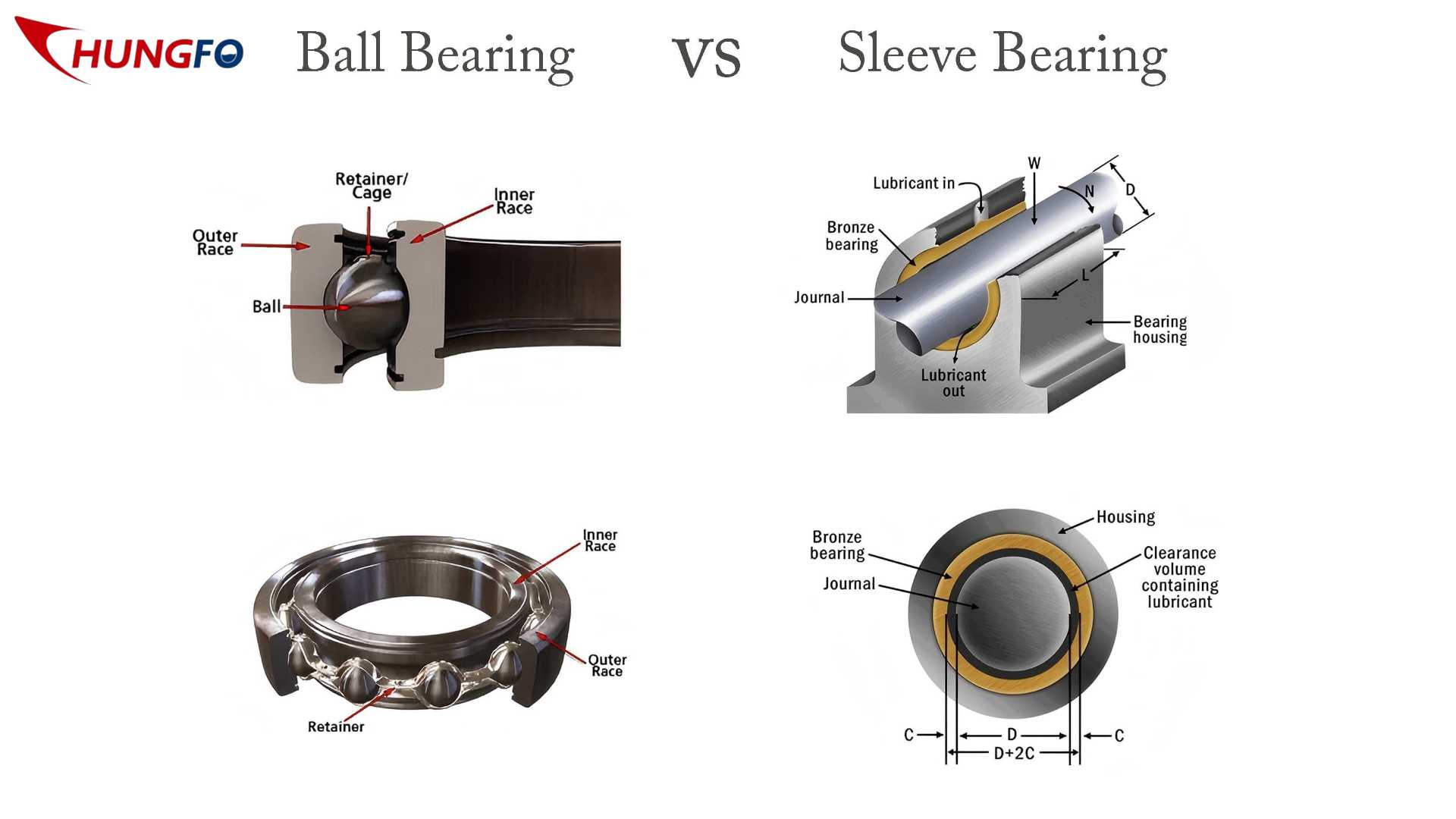
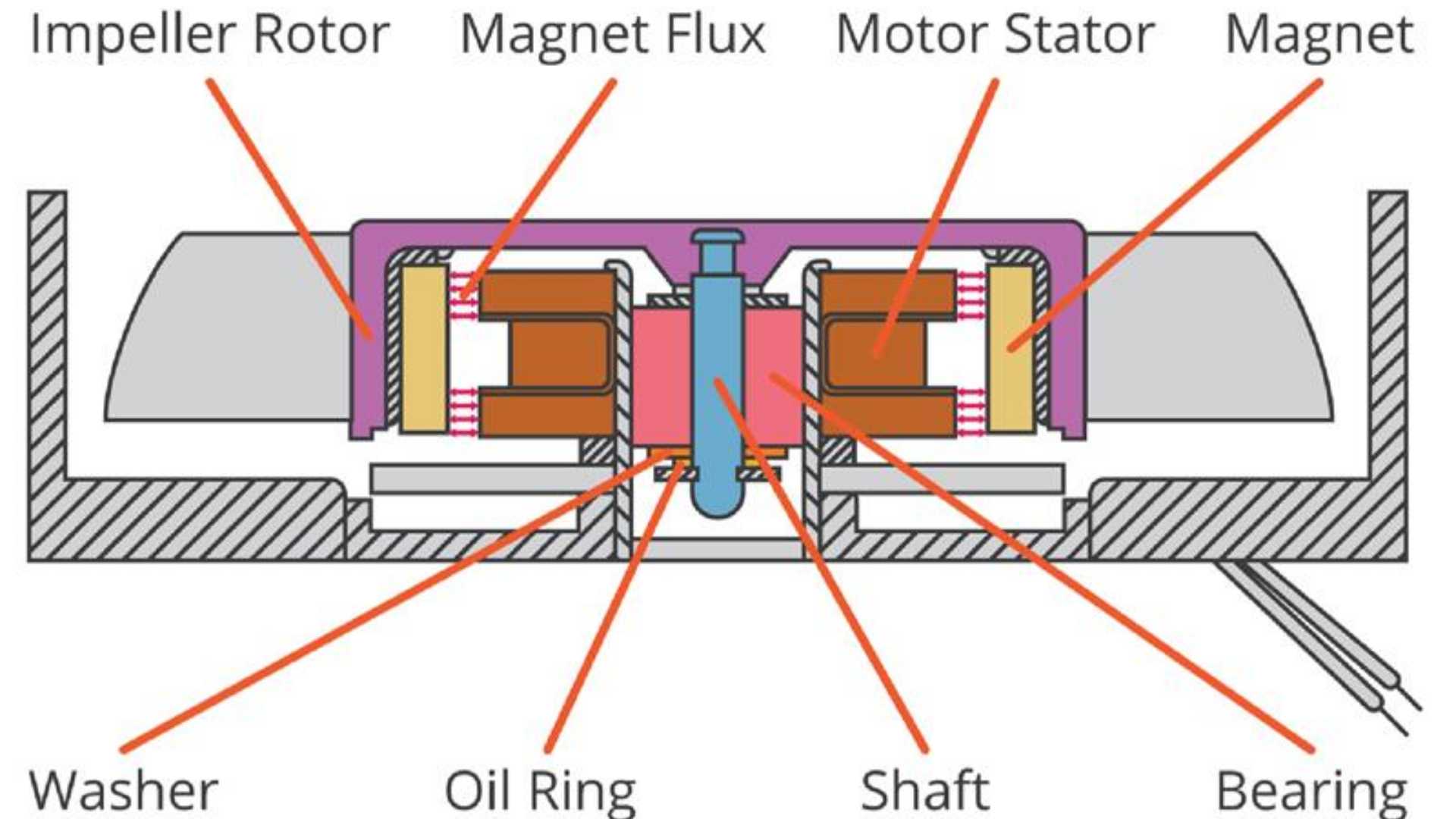
A sleeve bearing fan uses a cylindrical bearing sleeve to support the rotating shaft of the fan motor. The sleeve is usually manufactured from porous metal or other suitable bearing materials and contains lubricant that helps reduce friction during operation.
When the fan operates, the motor rotates the shaft and impeller. A lubricating film forms between the shaft and the bearing surface, reducing direct metal-to-metal contact and allowing relatively smooth rotation.
This design has been used in cooling fans for many years because it is relatively simple, compact, and economical to manufacture.
1.1 How Does a Sleeve Bearing Work?
The operating principle of a sleeve bearing is based on sliding friction and lubrication.
The main components include:
Rotating shaft: Connects the motor rotor to the fan impeller.
Bearing sleeve: Supports the shaft and maintains its rotational position.
Lubricant: Reduces friction and helps prevent excessive wear.
Bearing housing: Holds the bearing assembly in position.
During rotation, the lubricant helps form a protective film between the shaft and the sleeve. Under suitable operating conditions, this film separates the contacting surfaces and reduces wear.
However, lubrication conditions are important. If the lubricant deteriorates, migrates, becomes contaminated, or is insufficient for the operating environment, friction and wear may increase.
1.2 Advantages of Sleeve Bearing Fans
Cost Efficiency
Sleeve bearing structures are generally less complicated than ball bearing assemblies. This can reduce manufacturing costs and make sleeve bearing fans attractive for applications where the purchase price is an important consideration.
Compact Mechanical Structure
The simple bearing construction is suitable for many small cooling fans and compact electronic devices. It can be integrated into different fan sizes without requiring a complicated mechanical assembly.
Potentially Low Operating Noise
A properly manufactured and lubricated sleeve bearing fan can provide smooth and relatively quiet operation. This makes it suitable for certain consumer electronics and household appliances where acoustic performance matters.
Suitable for Conventional Cooling Applications
When operating temperature, mounting orientation, and expected operating hours are within the bearing's design limits, sleeve bearing fans can provide reliable service.
1.3 Limitations of Sleeve Bearing Fans
Sleeve bearings also have limitations that buyers should understand.
First, their performance depends significantly on lubrication. Changes in lubricant condition can influence friction, noise, and wear.
Second, some sleeve bearing designs are more sensitive to mounting orientation than ball bearing systems. The effect depends on the bearing structure, lubrication design, and shaft support arrangement.
Third, elevated temperatures and prolonged operation can accelerate lubricant degradation or migration in unsuitable designs.
Therefore, buyers should not evaluate a sleeve bearing fan only by its initial noise level or purchase price. The intended operating environment must also be considered.
2. What Is a Ball Bearing Fan?
A ball bearing fan uses small rolling elements positioned between an inner ring and an outer ring. These rolling elements support the rotating shaft and reduce friction during rotation.
Compared with a sleeve bearing, which relies on sliding contact and a lubricating film, a ball bearing uses rolling contact between its components.
Ball bearing systems are commonly selected for cooling fans that require consistent mechanical performance, extended operating periods, or installation in different orientations.
2.1 How Does a Ball Bearing Work?
A typical ball bearing assembly consists of several components:
Inner ring: Connected to or supported by the rotating shaft.
Outer ring: Positioned within the bearing housing.
Rolling balls: Transfer loads between the inner and outer rings.
Cage: Maintains appropriate spacing between the rolling elements.
Lubricant: Reduces friction and protects the rolling contact surfaces.
When the fan motor rotates, the shaft transfers rotational movement to the bearing assembly. The rolling elements move between the bearing rings, allowing the shaft to rotate with relatively low friction.
The design helps reduce sliding contact at the main bearing interface. However, rolling bearings still experience friction, contact stress, and lubricant degradation over time.
2.2 Single Ball Bearing vs. Double Ball Bearing
Not all ball bearing fans use the same bearing arrangement.
A single ball bearing configuration uses one ball bearing assembly in the motor support structure, while a double ball bearing configuration typically uses two ball bearings to support the shaft.
Double ball bearing arrangements are widely used in cooling fans that require greater shaft support and reliable operation under different mounting orientations.
Their potential advantages include:
Better shaft support at two positions.
Improved resistance to certain radial and axial loading conditions, depending on the design.
Greater flexibility in mounting orientation.
Suitability for many continuous-operation applications.
However, two ball bearings do not automatically mean twice the service life of a single-bearing design. The final result depends on bearing quality, preload, alignment, lubrication, shaft design, and operating conditions.
2.3 Advantages of Ball Bearing Fans
Better Mounting Flexibility
Ball bearing systems are generally less sensitive to gravity-related lubrication and shaft-support effects than many conventional sleeve bearing designs. This makes them suitable for equipment installed in different orientations.
Suitable for Demanding Operating Environments
Well-designed ball bearing fans can offer reliable performance in applications involving elevated temperatures and extended operating periods, provided that the bearing lubricant and materials are rated for the actual conditions.
Consistent Mechanical Support
The rolling elements and bearing rings provide defined mechanical support for the rotating shaft. Proper bearing selection and assembly can help maintain stable shaft positioning.
Long-Term Reliability Potential
Ball bearing fans are often selected when equipment requires extended operation or when fan replacement is inconvenient or costly.
2.4 Limitations of Ball Bearing Fans
Ball bearing fans also have disadvantages.
Their manufacturing costs are generally higher because the bearing assembly requires additional components and precision processing.
Depending on bearing quality, motor design, and fan speed, ball bearing systems may produce noticeable mechanical noise. However, this is not universal, and a well-designed ball bearing fan can achieve excellent acoustic performance.
Ball bearings also require suitable lubrication. Incorrect lubricant selection, contamination, excessive loading, or high operating temperatures can reduce their service life.
3. Sleeve Bearing vs. Ball Bearing: Key Differences
Understanding the structural differences is essential when selecting a cooling fan. The following table summarizes the major characteristics of the two bearing systems.
Comparison
Sleeve Bearing Fan
Ball Bearing Fan
Bearing structure
Cylindrical sleeve
Rolling elements and bearing rings
Main friction type
Sliding friction
Rolling contact with associated friction
Lubrication
Lubricating film between shaft and sleeve
Lubricant between rolling elements and raceways
Initial cost
Generally lower
Generally higher
Noise
Can be very quiet under suitable conditions
Depends on bearing precision and fan design
Mounting orientation
Some designs are more orientation-sensitive
Generally more flexible
High-temperature performance
Depends strongly on lubricant and construction
Often advantageous with suitable bearing specifications
Continuous operation
Suitable within design limits
Often preferred for demanding applications
Maintenance
Usually sealed or not intended for field servicing
Usually sealed or not intended for field servicing
Typical applications
Cost-sensitive electronics and appliances
Industrial equipment, servers, and demanding cooling systems
The table illustrates general design tendencies rather than universal performance guarantees. Different manufacturers may use different bearing materials, lubrication systems, shaft structures, and quality-control processes.
3.1 Which Bearing Has Lower Friction?
Sleeve bearings rely on a lubricating film to reduce friction between the shaft and the bearing surface. Under suitable conditions, this arrangement can operate smoothly.
Ball bearings use rolling contact, which reduces sliding at the primary rolling interface. Nevertheless, they still experience friction from rolling resistance, lubricant movement, cage interaction, and other internal effects.
Therefore, it is not accurate to conclude that one bearing type always has lower total friction in every operating condition.
3.2 Which Bearing Is More Cost-Effective?
Sleeve bearing fans generally have a lower initial purchase cost.
Ball bearing fans usually involve more complex bearing components and may have a higher unit price.
However, the initial purchase price is only one part of the total cost of ownership.
For equipment operating continuously, the cost of maintenance, replacement labor, equipment downtime, and production interruption may be more important than the difference in the original fan price.
A more expensive bearing system can be economically justified when it reduces replacement frequency or improves equipment availability.
4. Which Fan Bearing Lasts Longer?
This is the most important question for many engineers and purchasing professionals.
In general, ball bearing fans are often preferred for applications requiring extended operating periods, higher operating temperatures, and flexible mounting orientations. However, actual service life must be evaluated using the manufacturer's rated specifications and test conditions.
A bearing's life is not determined by its structural type alone.
Several operating factors can influence how long a cooling fan remains functional.
4.1 Operating Temperature
Temperature is one of the most important factors affecting bearing reliability.
As operating temperature increases, lubricant properties can change. Depending on the lubricant formulation, excessive heat may accelerate oxidation, reduce viscosity, increase evaporation, or shorten the useful lubrication period.
For sleeve bearings, the lubricant is particularly important because the bearing relies on a lubricating film between the shaft and sleeve.
Ball bearings also require lubrication. Their performance can deteriorate if grease or oil loses its intended properties under excessive heat.
When selecting a cooling fan for high-temperature applications, buyers should check:
A ball bearing fan may be the better choice for many demanding thermal environments, but only when the selected bearing and lubricant are properly specified.
4.2 Mounting Orientation
Cooling fans are installed in different positions depending on equipment design.
For example, a fan may be mounted horizontally on a control cabinet, vertically inside a server enclosure, or at an angle within a ventilation assembly.
Some conventional sleeve bearing designs are more sensitive to mounting orientation because gravity can influence lubricant distribution and shaft support.
Ball bearing systems generally offer greater flexibility in this respect because the rolling elements provide mechanical support through the bearing rings.
However, not all sleeve bearing fans have identical limitations. Advanced sleeve bearing designs may use structures and lubrication arrangements intended to support different mounting orientations.
Before installation, engineers should confirm the permitted mounting positions specified by the fan manufacturer.
4.3 Continuous Operating Hours
Many industrial cooling fans are expected to operate for long periods.
Examples include:
In these applications, bearing wear and lubricant condition become important reliability considerations.
Ball bearing fans are often selected for continuous-operation applications because of their mechanical structure and mounting flexibility.
However, continuous operation does not automatically guarantee a longer life for a ball bearing fan. Excessive speed, vibration, poor alignment, unsuitable lubricant, and high ambient temperatures can still cause premature failure.
The manufacturer's actual life rating and test conditions should always be reviewed.
4.4 Lubrication and Material Quality
Lubrication is essential for both bearing types.
For sleeve bearings, the lubricant helps maintain a protective film between the shaft and sleeve. The material's oil-retention characteristics and compatibility with the operating temperature can influence long-term performance.
For ball bearings, lubricant protects the rolling contact surfaces and helps reduce friction and wear. Grease selection, filling quantity, sealing, and contamination control are important.
Material quality also matters.
The shaft, bearing sleeve, bearing rings, rolling elements, and supporting housing must be designed to work together. Material compatibility, surface finish, hardness, and manufacturing tolerances can influence bearing performance.
This is why two fans with the same nominal bearing type may have different service-life results.
4.5 Manufacturing Precision and Assembly Quality
Even a high-quality bearing can perform poorly if it is installed incorrectly.
Important manufacturing considerations include:
Poor alignment can increase vibration and mechanical loading. An unbalanced rotor can create additional forces that accelerate wear.
For this reason, fan reliability depends on the entire manufacturing process rather than only the bearing component.
5. Noise Performance: Which Bearing Is Quieter?
Noise is another important consideration when choosing between sleeve bearing and ball bearing cooling fans.
For consumer electronics, home appliances, office equipment, and certain ventilation systems, low acoustic noise can directly influence product quality and user experience.
Sleeve bearing fans are often associated with relatively quiet operation because their mechanical structure can produce smooth rotation under suitable lubrication conditions.
Ball bearing fans may generate additional mechanical noise from rolling contact, cage movement, or bearing imperfections.
However, the actual noise difference depends on the complete fan design.
5.1 Factors That Influence Fan Noise
Bearing type is only one factor affecting total fan noise.
Other important factors include:
Higher rotational speed generally increases aerodynamic noise and can also increase mechanical noise.
Blade shape, blade number, tip clearance, and airflow characteristics influence turbulence and sound generation.
An imbalanced rotor can produce vibration, which may be transmitted through the fan housing and mounting structure.
Motor electromagnetic characteristics, commutation, and control methods can influence operating noise.
Loose screws, resonant mounting panels, and unsuitable airflow paths may amplify noise.
Therefore, purchasing professionals should evaluate the fan's measured noise level rather than selecting a bearing based on assumptions alone.
5.2 How Should Buyers Compare Noise Levels?
When comparing different cooling fans, buyers should request acoustic test data under clearly defined conditions.
Important details include:
A meaningful comparison requires similar testing conditions.
6. Which Bearing Is Better for Different Applications?
The best bearing depends on the equipment's operating requirements.
A low-cost fan for a compact household device may have very different requirements from a fan installed in a continuously operating industrial control cabinet.
6.1 Computer and Server Cooling
Server equipment requires reliable thermal management because high temperatures can affect electronic components and system stability.
Cooling fans may operate for extended periods and are often installed in fixed or vertically oriented assemblies.
Ball bearing fans are frequently considered for these applications because of their durability potential and mounting flexibility.
However, acoustic requirements, airflow, static pressure, and power consumption must also be considered.
6.2 Industrial Control Cabinets
Industrial control cabinets often contain power supplies, controllers, drives, and other heat-generating components.
Depending on the cabinet structure, cooling fans may operate in high ambient temperatures and different mounting orientations.
Ball bearing fans can be a suitable choice when the equipment requires long operating periods or increased mechanical reliability.
For less demanding applications, properly specified sleeve bearing fans may also provide an economical solution.
6.3 Household Appliances
Household appliances have diverse operating requirements.
Refrigerators, air purifiers, washing machines, dryers, and other appliances may require different combinations of airflow, noise control, temperature resistance, and product cost.
Sleeve bearing fans can be suitable for cost-sensitive applications when their operating conditions are compatible with the bearing design.
Ball bearing fans may be considered where higher reliability, temperature resistance, or mounting flexibility is required.
6.4 HVAC and Ventilation Equipment
HVAC systems may operate for extended periods and experience changes in ambient temperature.
The selection should consider the operating cycle, airflow resistance, installation orientation, and environmental conditions.
For applications involving extended operation or demanding installation requirements, ball bearing fans may offer advantages.
Nevertheless, the overall fan design, motor quality, and environmental protection should also be evaluated.
6.5 Power Electronics and Energy Storage Systems
Power electronics equipment and battery energy storage systems generate heat during operation.
Their cooling systems may need to maintain stable airflow under changing electrical loads and environmental conditions.
Bearing selection should be based on expected operating temperature, required service life, maintenance accessibility, and the consequences of cooling failure.
Ball bearing fans are often worth considering for applications where reliability and continuous operation are priorities.
7. How to Choose the Right Cooling Fan Bearing
Selecting a bearing should begin with the equipment's actual operating conditions rather than a general assumption that one bearing type is always superior.
The following checklist can help engineers and purchasing teams make a more informed decision.
7.1 Define the Required Operating Life
Determine the expected daily operating hours and total service period.
A fan used intermittently in a household appliance may have different requirements from one operating continuously in industrial equipment.
Ask the supplier for rated life data and the conditions under which the figures were established.
7.2 Confirm the Operating Temperature
Check both ambient temperature and the temperature surrounding the fan motor and bearing assembly.
Do not assume that the ambient air temperature is the same as the bearing operating temperature.
The temperature inside an enclosed device may be considerably higher.
7.3 Check the Mounting Orientation
Identify whether the fan will be installed horizontally, vertically, or at an angle.
Confirm that the selected bearing design supports the intended installation position.
7.4 Evaluate Noise Requirements
Determine the acceptable noise level for the finished equipment.
A fan that performs well in an industrial cabinet may not be appropriate for a quiet residential appliance.
Request acoustic data measured under defined conditions.
7.5 Match Airflow and Static Pressure
Bearing selection cannot compensate for an incorrectly specified fan.
The required airflow and static pressure should be evaluated according to the equipment's actual ventilation resistance.
A fan operating far from its intended performance range may create additional noise, heat, or operating inefficiency.
7.6 Evaluate Supplier Testing Capabilities
A reliable supplier should be able to explain how its cooling fans are evaluated.
Depending on the product and application, useful testing capabilities may include:
Fan airflow and static pressure testing.
Rotational speed and electrical performance testing.
Noise measurement.
Dynamic balancing.
High- and low-temperature testing.
Reliability and continuous-operation testing where applicable.
Buyers should request relevant test reports instead of relying only on general product descriptions.
8. How Does Manufacturing Quality Affect Bearing Life?
The bearing is important, but it is only one component of a complete cooling fan.
A reliable fan requires coordination between the bearing, motor, impeller, housing, electronic control system, and manufacturing process.
8.1 Motor and Shaft Design
The motor must provide stable rotation under the specified operating conditions.
Shaft dimensions, bearing positioning, rotor alignment, and mechanical clearances all influence the final operating condition.
An unsuitable shaft design or poor alignment may increase friction and vibration.
8.2 Dynamic Balance
The fan impeller and rotor should be manufactured and assembled with appropriate balance control.
Excessive imbalance can create vibration during rotation, increasing mechanical loading and potentially accelerating bearing wear.
Dynamic balancing is therefore an important quality-control process for many cooling fan products.
8.3 Temperature and Reliability Testing
Temperature testing helps evaluate whether a fan can operate under the intended thermal conditions.
Reliability testing may also be used to observe performance changes over time.
The test method should reflect the product's actual application requirements.
For example, a fan intended for a high-temperature industrial enclosure should not be evaluated solely under ordinary room-temperature conditions.
8.4 Production Consistency
A reliable manufacturing process should maintain consistent component dimensions, assembly quality, electrical performance, and product inspection standards.
This is particularly important for OEM and ODM projects involving repeated orders and large production volumes.
A supplier with integrated manufacturing and testing capabilities can help customers evaluate fan performance more systematically.
9. Why Work with China Chungfo Fan?
Selecting a cooling fan supplier involves more than comparing product prices and bearing types. Buyers also need to evaluate manufacturing experience, engineering support, customization capabilities, and quality-control processes.
China Chungfo Fan focuses on the research, development, manufacturing, and sales of DC fans, AC fans, blowers, cross-flow fans, frameless fans, and related motor products.
With manufacturing experience dating back to 2000, China Chungfo Fan supports customers across different industries with customized cooling and ventilation solutions.
The company's manufacturing base in Dongkeng Town, Dongguan, Guangdong, integrates several production processes, including product development, mold development, injection molding, SMT, assembly, and quality inspection.
Its production and testing capabilities support the evaluation of important fan performance characteristics, including:
For customers developing new equipment or optimizing existing cooling systems, selecting the correct fan bearing is only one part of the engineering process.
China Chungfo Fan can work with customers to evaluate fan dimensions, voltage, airflow, static pressure, noise requirements, operating temperature, and application conditions.
Whether a project requires a cost-effective sleeve bearing fan or a ball bearing cooling fan for more demanding operating conditions, the selection should be based on actual application requirements and verified product specifications.
For OEM and ODM projects, customers can discuss customized fan structures, electrical configurations, connection wires, and performance requirements with the engineering team.
10. Frequently Asked Questions
10.1 Which lasts longer, sleeve bearing or ball bearing fans?
Ball bearing fans generally offer advantages in applications involving extended operating periods, elevated temperatures, and different mounting orientations. However, actual service life depends on bearing quality, lubrication, manufacturing precision, and operating conditions.
10.2 Are ball bearing fans quieter than sleeve bearing fans?
Not necessarily. Sleeve bearing fans can provide quiet operation under suitable lubrication conditions. Ball bearing fans may produce additional mechanical noise, but the overall acoustic performance depends on motor design, fan speed, blade geometry, and manufacturing quality.
10.3 Can sleeve bearing fans run continuously?
Yes. Properly designed sleeve bearing fans can operate continuously within their specified temperature, orientation, and operating-life limits. Buyers should confirm the manufacturer's rated conditions before using them in demanding applications.
10.4 Are double ball bearing fans better than single ball bearing fans?
Double ball bearing arrangements provide shaft support at two positions and are commonly selected for demanding applications. However, they do not automatically offer twice the service life. Bearing quality, loading, lubrication, and assembly precision remain important.
10.5 Can a sleeve bearing fan be mounted vertically?
Some sleeve bearing designs support vertical installation, while others have restrictions. The permitted mounting orientation depends on the specific bearing structure and lubrication arrangement. Always consult the manufacturer's installation instructions.
10.6 Do ball bearing fans require maintenance?
Most small cooling fans use sealed or non-serviceable bearing assemblies and are not designed for routine field lubrication. Proper installation, clean airflow, and operation within the rated temperature range can help maintain reliability.
10.7 Which bearing is better for industrial cooling fans?
Ball bearings are often preferred for industrial applications involving extended operating hours, elevated temperatures, or flexible mounting orientations. Sleeve bearings can still be suitable for less demanding applications where cost efficiency is important.
10.8 How many hours can a cooling fan bearing last?
There is no single service-life value that applies to all cooling fan bearings. Rated life depends on the bearing design, lubricant, temperature, rotational speed, loading, and test method. Buyers should request product-specific life data and the associated test conditions.
Conclusion
Sleeve bearing and ball bearing fans each have advantages, and the best choice depends on the operating environment and equipment requirements.
Sleeve bearing fans are generally attractive for cost-sensitive applications where operating temperature, mounting orientation, and service-life requirements are compatible with the bearing design.
Ball bearing fans are often preferred for demanding applications that require extended operation, greater mounting flexibility, and reliable mechanical support.
However, bearing type alone cannot determine the overall service life of a cooling fan. Lubrication, motor design, shaft precision, rotor balance, manufacturing quality, and operating conditions all contribute to long-term performance.
For engineers and purchasing professionals, the most effective approach is to evaluate the complete fan specification and verify the manufacturer's testing data before making a decision.
China Chungfo Fan provides customized DC and AC cooling fan solutions for different industrial and commercial applications. By combining application evaluation, engineering support, manufacturing capabilities, and quality control, the company helps customers identify suitable cooling solutions for their equipment.