Categorías
Nuevo blog
¿Cómo mejoran los ventiladores de circulación de aire la eficiencia energética de los refrigeradores?
August 14 , 2026Los refrigeradores son uno de los electrodomésticos más importantes que funcionan continuamente. A diferencia de las lavadoras, los hornos microondas y otros electrodomésticos que solo funcionan durante períodos relativamente cortos, los refrigeradores normalmente funcionan durante todo el día y durante todo el año para mantener una temperatura interna estable. Por lo tanto, incluso un componente pequeño con un consumo de energía relativamente bajo puede tener una influencia notable en el consumo total de energía cuando funciona continuamente.
Cuando los fabricantes hablan de la eficiencia energética de los refrigeradores, los primeros componentes que suelen recibir atención son el compresor, el refrigerante, el evaporador, el condensador, los materiales de aislamiento y el sistema de control de temperatura. Estos componentes son indudablemente importantes, pero hay otro factor que merece la misma atención: la circulación de aire.
La forma en que el aire se mueve dentro de un refrigerador influye directamente en la distribución de temperatura, la utilización de la capacidad de enfriamiento, la transferencia de calor, el funcionamiento del compresor, el rendimiento de descongelación y la experiencia del usuario.
Un ventilador de circulación de aire puede parecer un componente relativamente pequeño, pero desempeña un papel importante en la distribución del aire frío por todo el refrigerador. Cuando el ventilador, el conducto de aire, el evaporador y el sistema de control están correctamente coordinados, el aire frío puede llegar a las diferentes zonas de almacenamiento de manera más uniforme. Esto puede reducir las diferencias locales de temperatura y ayudar al sistema de refrigeración a funcionar de manera más eficiente.
Por lo tanto, evaluar un ventilador de refrigerador no debería limitarse a su flujo de aire máximo. Los ingenieros también deberían considerar el flujo de aire bajo la resistencia real del sistema, la presión estática, la potencia eléctrica, el ruido, las dimensiones, la temperatura de funcionamiento y la fiabilidad a largo plazo.
¿Por qué un refrigerador necesita circulación de aire?
La temperatura dentro de un refrigerador rara vez es completamente uniforme.
Cuando el evaporador elimina calor del aire circundante, la temperatura del aire disminuye. El aire frío se ve afectado por la gravedad, la densidad del aire, los estantes, los paquetes de alimentos, los cajones, las divisiones y los conductos de aire internos. Como resultado, el aire más frío puede acumularse en ciertas zonas mientras que el aire más cálido permanece más lejos de la fuente de enfriamiento.
Si el refrigerador depende principalmente de la convección natural, el movimiento del aire puede ser relativamente lento. Las estructuras internas pueden restringir aún más el flujo de aire e impedir que el aire frío llegue eficazmente a todas las partes del gabinete.
Esto puede crear una situación común en la que una parte del refrigerador ya está muy fría mientras que otra parte permanece relativamente cálida.
Por ejemplo, la zona cercana al evaporador puede haber alcanzado ya una temperatura baja, mientras que la zona de la puerta, la sección superior o una sección bloqueada por alimentos puede permanecer más cálida. Si el sistema de control de temperatura responde a la zona más cálida, el compresor puede continuar funcionando.
En este caso, el sistema de refrigeración puede haber producido ya suficiente capacidad de enfriamiento, pero esa capacidad no se ha distribuido eficientemente por todo el espacio de almacenamiento.
Aquí es donde un ventilador de circulación de aire se vuelve importante.
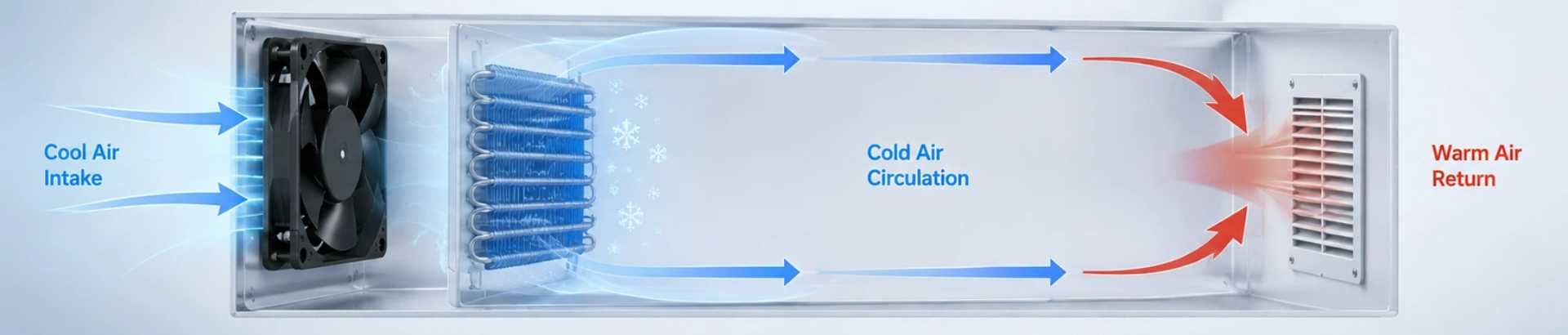
El ventilador obliga al aire a moverse continuamente por el refrigerador. Puede transportar el aire frío lejos del evaporador y distribuirlo a otras zonas mientras lleva el aire más cálido de regreso hacia la zona de enfriamiento.
Esta circulación forzada reduce la estratificación de temperatura y crea un intercambio de calor más eficaz entre diferentes zonas.

¿Cómo ayuda la circulación de aire a reducir el consumo de energía?
La relación entre la circulación de aire y la eficiencia energética del refrigerador está estrechamente relacionada con la utilización de la capacidad de enfriamiento.
Cuando el compresor funciona, el refrigerante circula por el sistema de refrigeración y el evaporador absorbe calor del compartimento del refrigerador. Si el aire frío permanece concentrado alrededor del evaporador debido a un flujo de aire insuficiente, el aire de baja temperatura puede no utilizarse de manera eficiente.
El aire alrededor del evaporador ya ha recibido capacidad de enfriamiento, pero sin suficiente movimiento no puede enfriar eficazmente las zonas más cálidas ubicadas en otras partes del refrigerador.
Un ventilador de circulación de aire mueve continuamente este aire.
El aire más cálido se lleva hacia la zona de enfriamiento mientras que el aire más frío se distribuye por todo el refrigerador.
Esto aumenta el intercambio de calor efectivo y permite que la capacidad de enfriamiento disponible se utilice de manera más eficiente.
Desde una perspectiva del sistema, esto es extremadamente importante.
Si la temperatura dentro del refrigerador se vuelve más uniforme, el sistema de control puede no necesitar mantener una temperatura general innecesariamente baja simplemente porque una zona local permanece cálida.
El compresor también puede tener la oportunidad de reducir tiempos de funcionamiento innecesarios.
Por lo tanto, aunque el ventilador de circulación consume energía eléctrica por sí mismo, aún puede contribuir al ahorro energético neto si la energía que consume produce una mejora en la eficiencia de enfriamiento y reduce el funcionamiento del compresor.
Esta es la razón por la que la eficiencia del ventilador del refrigerador debe evaluarse a nivel del sistema en lugar de observar únicamente el consumo de energía del propio ventilador.
El objetivo no es simplemente elegir el ventilador de menor potencia.
En su lugar, los ingenieros deberían encontrar el equilibrio adecuado entre la potencia del ventilador, el flujo de aire, la presión estática, la uniformidad de temperatura, el tiempo de funcionamiento del compresor, el ruido y la fiabilidad.
¿Por qué es tan importante la uniformidad de temperatura?
La uniformidad de temperatura es una de las consideraciones más importantes en el diseño de refrigeradores.
Considere un refrigerador en el que una zona está cerca de 0 °C mientras que otra alcanza 6 °C. Si el fabricante quiere que todas las zonas permanezcan dentro de un rango de temperatura relativamente bajo, el sistema de refrigeración puede necesitar funcionar según la zona más cálida.
Si la circulación de aire puede reducir la diferencia de temperatura entre estas ubicaciones, el refrigerador puede lograr mejores condiciones de almacenamiento sin reducir innecesariamente el ajuste general de temperatura.
La uniformidad de temperatura también es importante para la calidad de los alimentos.
Diferentes alimentos tienen distintos requisitos de temperatura. Las verduras, las frutas, los productos lácteos, las bebidas y otros alimentos pueden responder de manera diferente a las fluctuaciones de temperatura.
Un punto frío local puede hacer que algunos productos se congelen, mientras que una zona cálida puede reducir la calidad de almacenamiento.
Por lo tanto, un sistema eficaz de circulación de aire necesita hacer más que proporcionar un alto flujo de aire.
Debe distribuir la capacidad de enfriamiento de manera controlada y equilibrada.
El ventilador de circulación de aire puede considerarse un distribuidor de capacidad de enfriamiento dentro del refrigerador.
¿Por qué un flujo de aire máximo no siempre significa una eficiencia máxima?
El flujo de aire máximo suele ser la primera especificación que las personas consideran al seleccionar un ventilador. Sin embargo, el flujo de aire máximo por sí solo no es suficiente para las aplicaciones de refrigeradores.
El flujo de aire máximo de un ventilador normalmente se mide bajo condiciones de baja resistencia del sistema o de aire libre.
Una vez instalado el ventilador dentro de un refrigerador, el aire puede tener que pasar por un evaporador, un conducto de aire, una cubierta, un filtro, una placa guía y una salida.
Cada componente genera resistencia.
Un ventilador con una clasificación de flujo de aire en aire libre muy alta no necesariamente proporcionará un flujo de aire elevado después de la instalación si no tiene suficiente capacidad de presión estática.
Por otro lado, un ventilador con una clasificación de flujo de aire máximo moderada puede funcionar muy bien en un refrigerador real si puede mantener un flujo de aire estable bajo la resistencia del sistema.
Por esta razón, los fabricantes de refrigeradores deberían prestar atención al punto de funcionamiento del ventilador en lugar de seleccionar un producto únicamente según su flujo de aire máximo.
El flujo de aire, la presión estática, el consumo de energía y el ruido deben evaluarse conjuntamente.
Si el ventilador tiene que funcionar a una velocidad muy alta para superar la resistencia del sistema, el consumo eléctrico y el ruido pueden aumentar.
Por lo tanto, un ventilador eficiente debe proporcionar un flujo de aire suficiente con un nivel de potencia razonable bajo condiciones reales de funcionamiento.
Ventiladores axiales y sopladores para aplicaciones de refrigeradores
Diferentes estructuras de refrigeradores requieren diferentes soluciones de flujo de aire.
Los ventiladores axiales generalmente son adecuados para aplicaciones donde la trayectoria del flujo de aire es relativamente directa y la resistencia del sistema es moderada.
Normalmente proporcionan un buen flujo de aire en una estructura compacta y pueden utilizarse para ciertas aplicaciones de circulación de aire del refrigerador y enfriamiento del condensador.
Los sopladores son más adecuados cuando el flujo de aire debe dirigirse por una trayectoria específica o cuando el sistema tiene una resistencia relativamente alta.
Un soplador puede concentrar el flujo de aire en una dirección determinada y, por lo tanto, ofrece mayor flexibilidad cuando el refrigerador contiene conductos de aire estrechos o complejos.
Por ejemplo, algunos sistemas compactos de refrigeración no pueden mover el aire directamente desde el evaporador hasta todo el compartimento refrigerado. En su lugar, el aire debe pasar por un conducto relativamente estrecho o prolongado.
En esta situación, un soplador puede proporcionar una solución de flujo de aire más adecuada.
Para aplicaciones compactas de bajo voltaje, también puede considerarse un mini ventilador soplador 5v cuando la potencia eléctrica disponible y el espacio de instalación son limitados.
Este concepto de soplador compacto puede ser útil en equipos pequeños de refrigeración, productos de enfriamiento portátiles, electrodomésticos compactos y otras aplicaciones que requieren un flujo de aire direccional.
No existe una estructura de ventilador universalmente mejor para todos los refrigeradores.
La elección más adecuada depende de la relación entre el ventilador y el conducto de aire real.
¿Cómo se debe seleccionar el tamaño del ventilador del refrigerador?
El tamaño del ventilador influye directamente en la estructura del refrigerador.
Si un ventilador es demasiado grande, puede ocupar un espacio interno valioso y dificultar el diseño del conducto de aire.
Si un ventilador es demasiado pequeño, puede necesitar funcionar a una velocidad más alta para producir el flujo de aire requerido.
Una velocidad de rotación más alta puede provocar un aumento del ruido, el consumo de energía, la vibración y la tensión mecánica.
Sin embargo, un ventilador más pequeño no significa necesariamente un menor rendimiento.
La tecnología moderna de motores, el diseño del impulsor y la optimización aerodinámica permiten que los ventiladores compactos proporcionen un flujo de aire estable con un consumo de energía relativamente bajo.
Esto es especialmente útil para mini refrigeradores, enfriadores de vino, enfriadores de bebidas, equipos portátiles de refrigeración y otros productos con limitaciones de espacio.
Una solución compacta de flujo de aire como unventilador USB de 60 mmpuede ilustrar las ventajas de los equipos compactos de flujo de aire en aplicaciones de bajo voltaje. Sin embargo, el ventilador del refrigerador real siempre debe seleccionarse según el voltaje, las condiciones ambientales, los requisitos de flujo de aire y la resistencia del sistema de la aplicación final.
Para algunas aplicaciones electrónicas y de electrodomésticos compactos, unventilador de caja de 60 mmtambién puede proporcionar una referencia útil para la categoría de tamaño de productos de enfriamiento compactos. Sin embargo, los fabricantes de refrigeradores no deben seleccionar un ventilador basándose únicamente en las dimensiones.
La selección correcta requiere un análisis completo del flujo de aire, la presión estática, el consumo de energía, el ruido, las condiciones de instalación y el rendimiento térmico.
¿Por qué es importante el bajo ruido en los ventiladores de los refrigeradores?
Los refrigeradores normalmente funcionan de forma continua, por lo que el ruido del ventilador puede tener una influencia directa en la experiencia del usuario.
Esto es especialmente importante en hogares modernos con cocinas abiertas, apartamentos pequeños, oficinas, hoteles y otros entornos donde las personas pueden permanecer cerca del refrigerador durante largos períodos.
El ruido del ventilador no proviene únicamente del motor.
También puede generarse por la aerodinámica de las aspas, la turbulencia del flujo de aire, la vibración, el desequilibrio del impulsor, el funcionamiento de los rodamientos y la estructura de instalación.
Por lo tanto, reducir el ruido del ventilador del refrigerador requiere un enfoque integral.
Primero, el equilibrado dinámico es importante.
Si el impulsor no está equilibrado correctamente, puede generar vibraciones periódicas cuando funciona a alta velocidad.
Segundo, el diseño del motor es importante.
Un motor sin escobillas de alta calidad puede proporcionar una rotación estable mientras reduce ciertas pérdidas mecánicas.
Tercero, se debe considerar el diseño del conducto de aire.
Incluso cuando el propio ventilador tiene poco ruido, una salida mal diseñada puede crear turbulencias y ruido aerodinámico.
Por lo tanto, el diseño de refrigeradores de bajo ruido es el resultado de la cooperación entre el ventilador, el conducto de aire, la estructura de montaje, el motor y el impulsor.
¿Por qué los refrigeradores sin escarcha dependen más de la circulación de aire?
En comparación con los refrigeradores tradicionales de enfriamiento directo, los refrigeradores sin escarcha generalmente dependen más de la circulación de aire forzada.
Un sistema de refrigeración sin escarcha utiliza un ventilador para mover el aire alrededor del evaporador y distribuir el aire enfriado mediante conductos de aire específicos.
Por lo tanto, el ventilador participa directamente en el transporte de la capacidad de enfriamiento.
Si el diseño del flujo de aire no está optimizado, algunas zonas pueden enfriarse excesivamente mientras que otras no reciben suficiente enfriamiento.
Esto puede provocar temperaturas desiguales en todo el refrigerador.
La circulación de aire también está estrechamente relacionada con la formación de escarcha en el evaporador.
Cuando la humedad del aire entra en contacto con la superficie fría del evaporador, puede formarse escarcha. A medida que la escarcha se acumula, aumenta la resistencia térmica y el rendimiento de transferencia de calor puede disminuir.
Un sistema de flujo de aire correctamente diseñado puede mejorar el intercambio de aire alrededor del evaporador y trabajar junto con el sistema de descongelación para mantener un rendimiento estable.
Por esta razón, el ventilador de un refrigerador sin escarcha no debe considerarse simplemente un componente auxiliar.
Forma parte del sistema de refrigeración.
Control del ventilador durante el proceso de descongelación
La descongelación también tiene una influencia importante en la eficiencia energética del refrigerador.
Cuando se acumula una capa de escarcha en el evaporador, la transferencia de calor se vuelve menos efectiva. Por lo tanto, el refrigerador necesita realizar un proceso de descongelación para restaurar el rendimiento del evaporador.
Sin embargo, el calor generado durante la descongelación no debería propagarse innecesariamente al área de almacenamiento de alimentos.
Si entra demasiado aire caliente en el congelador o en el compartimento del refrigerador durante la descongelación, el compresor puede necesitar consumir energía adicional después para recuperar la temperatura objetivo.
Por esta razón, la gestión del flujo de aire durante la descongelación es importante.
Dependiendo de la arquitectura del refrigerador, el ventilador de circulación puede detenerse durante parte del ciclo de descongelación para evitar que el aire caliente se extienda al área de almacenamiento.
Después de la descongelación, el ventilador puede reiniciarse según las condiciones de temperatura y el programa de control.
Este funcionamiento basado en la demanda puede ayudar a evitar un consumo innecesario de energía.
¿Cómo puede el control inteligente del ventilador reducir aún más el consumo de energía?
A medida que los electrodomésticos inteligentes continúan desarrollándose, los ventiladores de los refrigeradores están avanzando más allá del simple control de encendido y apagado.
Los sistemas de control modernos pueden ajustar el funcionamiento del ventilador según varios parámetros.
Por ejemplo, cuando se abre la puerta del refrigerador, el aire caliente de la habitación entra en el compartimento.
El sistema de control puede modificar temporalmente la estrategia de flujo de aire para restaurar el ambiente interno.
Cuando se coloca una gran cantidad de alimentos a temperatura ambiente dentro del refrigerador, una circulación de aire más intensa puede ayudar a distribuir la capacidad de enfriamiento y acelerar la recuperación de la temperatura.
Una vez que la temperatura interna se estabiliza, la velocidad del ventilador puede reducirse o el ventilador puede detenerse cuando sea adecuado.
Esto puede reducir el consumo innecesario de electricidad.
Los motores de CC sin escobillas son especialmente adecuados para el control inteligente de ventiladores porque su velocidad puede controlarse electrónicamente.
El control PWM es un método común.
Al ajustar las condiciones de funcionamiento del motor, el ventilador puede operar según la demanda térmica real en lugar de funcionar continuamente a la velocidad máxima.
Este enfoque es coherente con la dirección de desarrollo de los refrigeradores modernos de bajo consumo energético.
¿Cómo seleccionar el ventilador de circulación de aire adecuado para un refrigerador?
Para los fabricantes de refrigeradores, la selección del ventilador debe comenzar con el sistema completo de refrigeración.
Primero, determine las dimensiones de instalación disponibles.
Se deben considerar la longitud, el ancho, la altura, la posición de los orificios de montaje, la dirección del cable y el método de montaje.
Segundo, determine el flujo de aire requerido.
Los requisitos de flujo de aire dependen del volumen del gabinete, el rendimiento del evaporador, la estructura del conducto de aire, los objetivos de uniformidad de temperatura y los requisitos de enfriamiento.
Tercero, evalúe la presión estática.
Si el refrigerador contiene conductos largos, salidas estrechas, filtros, cubiertas u otros componentes restrictivos, la presión estática adquiere especial importancia.
Cuarto, determine el voltaje de funcionamiento.
La alimentación de CC de bajo voltaje se utiliza ampliamente en electrodomésticos modernos, lo que hace que los ventiladores de CC sean adecuados para integrarse con muchos sistemas de control.
Quinto, considere el consumo de energía.
Dado que los ventiladores de refrigeradores pueden funcionar durante largos períodos, incluso una pequeña diferencia en la potencia eléctrica puede acumularse durante miles de horas de funcionamiento.
Sexto, evalúe el ruido.
El bajo nivel de ruido es especialmente importante para los refrigeradores domésticos.
Séptimo, considere las condiciones ambientales y la fiabilidad.
El entorno del refrigerador puede incluir bajas temperaturas, humedad, condensación, arranques y paradas frecuentes, y largos períodos de funcionamiento continuo.
Por lo tanto, el ventilador seleccionado debe ser capaz de funcionar de manera estable bajo las condiciones reales de aplicación.
Finalmente, las pruebas reales del sistema son esenciales.
Idealmente, el flujo de aire, la presión estática, la distribución de temperatura, el ruido, la vibración y el consumo de energía deben probarse después de instalar el ventilador en el conducto de aire real.
Solo las pruebas reales del sistema pueden determinar si un ventilador es realmente adecuado para el refrigerador.
Soluciones de ventiladores de refrigeración para refrigeradores de Guangdong Chungfo
Guangdong Chungfo se especializa en el desarrollo y la fabricación de productos de gestión térmica, incluidos ventiladores de CC, ventiladores de CA, ventiladores axiales, sopladores y ventiladores de flujo cruzado.
Para refrigeradores y otros equipos de refrigeración, la empresa se centra no solo en el rendimiento del ventilador, sino también en la relación entre el ventilador y el sistema completo de enfriamiento.
Los diferentes refrigeradores tienen distintos espacios internos, estructuras de conductos de aire, requisitos eléctricos, cargas térmicas y resistencias al flujo de aire.
Por lo tanto, un ventilador estándar no es necesariamente adecuado para todos los refrigeradores.
Guangdong Chungfo puede apoyar la selección y el desarrollo de productos según los requisitos del cliente, como dimensiones, voltaje nominal, corriente, velocidad, flujo de aire, presión estática, ruido, estructura de montaje y entorno de funcionamiento.
La empresa cuenta con capacidades de fabricación integradas que abarcan el diseño de productos, el moldeo por inyección, la producción SMT y el ensamblaje final.
Sus capacidades de prueba incluyen equilibrado dinámico, pruebas de corrosión por niebla salina, pruebas de presión en túnel de viento, pruebas de alta y baja temperatura, pruebas de ruido y otras evaluaciones del rendimiento del producto.
Estas capacidades ayudan a verificar el rendimiento del ventilador bajo diferentes condiciones de funcionamiento.
Para los fabricantes de refrigeradores, un proveedor adecuado de ventiladores debe ofrecer más que un producto estándar de catálogo.
Un proveedor profesional debe comprender el conducto de aire real del cliente, los requisitos térmicos, las limitaciones de instalación, el sistema eléctrico y las expectativas de fiabilidad a largo plazo.
Guangdong Chungfo puede proporcionar soluciones de flujo de aire para refrigeradores domésticos, mini refrigeradores, enfriadores de vino, equipos comerciales de refrigeración y otros electrodomésticos que requieren una circulación de aire fiable.
Del rendimiento del ventilador a la eficiencia del sistema
La eficiencia energética de un refrigerador no está determinada por un solo componente.
Un compresor altamente eficiente no puede resolver por completo un diseño de flujo de aire ineficiente.
Un evaporador de alto rendimiento puede no ofrecer todo su potencial si la circulación de aire es insuficiente.
Un ventilador de muy baja potencia puede no ser adecuado si no puede superar la presión estática real del conducto de aire.
Esto significa que el refrigerador debe diseñarse como un sistema integrado de gestión térmica.
El propósito de un ventilador de circulación de aire no es simplemente generar el máximo flujo de aire.
Su función más importante es suministrar la capacidad de enfriamiento de forma precisa, constante y eficiente a las áreas que la necesitan.
Por eso, el diseño de los ventiladores de refrigeradores está pasando gradualmente de la optimización a nivel de componentes hacia la optimización a nivel de sistema.
Tendencias futuras en la tecnología de circulación de aire de refrigeradores
Los refrigeradores del futuro darán mayor importancia a la eficiencia energética, el control inteligente, la fiabilidad y la comodidad del usuario.
Los ventiladores pasarán cada vez más del funcionamiento a velocidad fija hacia el control de velocidad variable y basado en la demanda.
Los motores sin escobillas más eficientes, la geometría mejorada de las aspas, los conductos de aire optimizados, los sistemas de control de menor consumo y una retroalimentación de temperatura más precisa pueden mejorar aún más la eficiencia de la circulación de aire.
Al mismo tiempo, los tamaños de los productos de refrigeración son cada vez más diversos.
Los refrigeradores grandes de múltiples puertas, los refrigeradores compactos, las vinotecas, los enfriadores de bebidas, los productos de refrigeración portátiles y los sistemas comerciales de enfriamiento tienen requisitos de flujo de aire diferentes.
Esto significa que el tamaño compacto, el bajo consumo de energía, la alta fiabilidad y el bajo nivel de ruido seguirán siendo direcciones importantes de desarrollo para los ventiladores de refrigeradores.
Por qué la circulación de aire es importante para la eficiencia energética del refrigerador a largo plazo
La importancia de la circulación de aire se vuelve aún más evidente al considerar la larga vida operativa de un refrigerador.
Un refrigerador puede funcionar durante miles de horas cada año. Por lo tanto, pequeñas mejoras que parecen insignificantes durante un solo ciclo de funcionamiento pueden adquirir importancia a lo largo de varios años.
Por ejemplo, si un mejor flujo de aire reduce el tiempo promedio de funcionamiento del compresor, mejora la estabilidad de la temperatura y reduce los ciclos de enfriamiento innecesarios, el ahorro energético acumulado puede ser significativo.
Del mismo modo, un ventilador con un consumo de energía ligeramente menor puede reducir la energía eléctrica consumida por el propio ventilador durante su vida útil.
Por eso, los fabricantes de refrigeradores deben evaluar la eficiencia del ventilador durante la vida útil esperada del aparato en lugar de considerar únicamente el precio inicial de compra.
El costo total de propiedad incluye el consumo de energía, el mantenimiento, la fiabilidad, el ruido, los requisitos de sustitución y el rendimiento del producto.
Un sistema de circulación de aire bien diseñado puede contribuir a varios de estos factores simultáneamente.
La relación entre el flujo de aire y la calidad de almacenamiento de los alimentos
La eficiencia energética no es la única razón para mejorar el flujo de aire del refrigerador.
La uniformidad de la temperatura también afecta la calidad de almacenamiento de los alimentos.
Diferentes áreas dentro de un refrigerador pueden experimentar distintas condiciones térmicas según su distancia del evaporador y la ubicación de las salidas de aire.
Si la circulación de aire es deficiente, algunos alimentos pueden experimentar un enfriamiento excesivo mientras que otros permanecen en zonas más cálidas.
Para los fabricantes, esto significa que la distribución del flujo de aire debe diseñarse según los requisitos reales de almacenamiento.
La posición de los estantes, cajones, salidas de aire, conductos de retorno de aire y cubiertas del evaporador puede influir en la distribución de la temperatura.
Por lo tanto, un ventilador correctamente seleccionado debe combinarse con un conducto de aire diseñado cuidadosamente.
En algunas aplicaciones, el mejor resultado no se obtiene aumentando la velocidad del ventilador.
En su lugar, cambiar la dirección y distribución del flujo de aire puede proporcionar una mejor uniformidad de temperatura con un menor consumo de energía.
Esta es otra razón por la que las pruebas térmicas a nivel de sistema son importantes.
Por qué el diseño del conducto de aire y la selección del ventilador deben funcionar juntos
El ventilador y el conducto de aire nunca deben tratarse como componentes completamente independientes.
El ventilador genera el flujo de aire, mientras que el conducto de aire determina hacia dónde se dirige ese flujo.
Un conducto mal diseñado puede generar una resistencia excesiva, turbulencia, zonas muertas y una distribución desigual.
Si los ingenieros intentan resolver estos problemas simplemente aumentando la velocidad del ventilador, el consumo de energía y el ruido pueden aumentar sin lograr la distribución de temperatura deseada.
Una solución mejor es optimizar tanto el ventilador como el conducto de aire.
Esto puede implicar ajustar las dimensiones de las salidas, cambiar la dirección del flujo de aire, mejorar las rutas de retorno de aire, reducir curvas innecesarias o seleccionar un ventilador con una característica de presión-flujo más adecuada.
En otras palabras, el ventilador con mayor eficiencia energética no es necesariamente el ventilador con la potencia nominal más baja.
Es el ventilador el que proporciona el rendimiento requerido del sistema con el menor costo energético total práctico.
El papel de la fabricación de ventiladores confiable
El funcionamiento a largo plazo del refrigerador impone altos requisitos de confiabilidad al ventilador.
Un ventilador puede arrancar y detenerse repetidamente según la estrategia de control, mientras que algunos sistemas pueden requerir un funcionamiento continuo durante períodos prolongados.
El desequilibrio mecánico, el desgaste de los rodamientos, la inestabilidad del motor o las fallas electrónicas pueden afectar eventualmente el rendimiento del flujo de aire.
Por esta razón, la calidad de fabricación está estrechamente relacionada con la confiabilidad del sistema del refrigerador.
El equilibrado dinámico puede ayudar a reducir la vibración causada por el desequilibrio del impulsor.
Las pruebas de alta y baja temperatura pueden ayudar a evaluar el funcionamiento bajo diferentes condiciones térmicas.
Las pruebas de ruido pueden identificar comportamientos anómalos de funcionamiento.
Las pruebas de flujo de aire y presión estática pueden verificar si el producto cumple sus objetivos de diseño.
Por lo tanto, un sistema completo de control de calidad desempeña un papel importante en el mantenimiento de un rendimiento constante del ventilador de un lote de producción a otro.
Por qué los ventiladores personalizados para refrigeradores pueden ser valiosos
Aunque los ventiladores estándar son adecuados para muchas aplicaciones, las soluciones de ventiladores personalizados pueden ofrecer ventajas cuando el refrigerador tiene requisitos inusuales de espacio, flujo de aire o eléctricos.
Por ejemplo, un fabricante puede requerir un patrón específico de orificios de montaje, longitud de cable, dirección de rotación, rango de flujo de aire, voltaje de funcionamiento o límite de ruido.
Un producto estándar de catálogo puede no satisfacer todos estos requisitos simultáneamente.
Se puede desarrollar una solución personalizada en torno a la estructura real del refrigerador.
Este enfoque puede ayudar a optimizar el ventilador y el conducto de aire como un sistema completo en lugar de obligar al diseño del electrodoméstico a adaptarse a un ventilador existente.
Para los fabricantes de refrigeradores OEM y ODM, esta flexibilidad puede ser especialmente valiosa durante el desarrollo del producto.
Conclusión
Un ventilador de circulación de aire puede ser un componente relativamente pequeño dentro de un refrigerador, pero su influencia en el sistema general de refrigeración puede ser significativa.
Un flujo de aire adecuado puede mejorar la utilización de la capacidad de enfriamiento, la uniformidad de temperatura, la transferencia de calor del evaporador, el funcionamiento del compresor, el rendimiento de descongelación y el confort del usuario.
Un refrigerador energéticamente eficiente no es simplemente un refrigerador equipado con un compresor altamente eficiente.
Es un sistema integrado en el que el compresor, evaporador, condensador, ventilador, conductos de aire, sensores, aislamiento y sistema de control trabajan juntos.
El objetivo de la circulación de aire no es producir el mayor flujo de aire posible.
El objetivo es lograr el flujo de aire más eficaz con un nivel adecuado de potencia eléctrica, presión estática, ruido y uniformidad de temperatura.
Por lo tanto, para los fabricantes de refrigeradores, la selección del ventilador debe basarse en el punto de funcionamiento real del sistema en lugar de una única especificación de catálogo.
Cuando se combinan bajo consumo de energía, tecnología de motor confiable, flujo de aire optimizado, control inteligente y selección adecuada del ventilador, un ventilador de circulación compacto puede contribuir a una mejor eficiencia general de refrigeración.
A medida que continúan desarrollándose los electrodomésticos energéticamente eficientes y las tecnologías de refrigeración inteligente, la gestión optimizada del flujo de aire será cada vez más importante.
Para los fabricantes de ventiladores, esto también significa que la competencia futura no se basará únicamente en el flujo de aire y el precio. La eficiencia, confiabilidad, rendimiento acústico, soporte de ingeniería y gestión térmica a nivel de sistema se convertirán en factores cada vez más importantes.
Preguntas frecuentes
¿Qué hace un ventilador de circulación de aire en un refrigerador?
Un ventilador de circulación de aire mueve el aire dentro del refrigerador y ayuda a distribuir el aire enfriado de manera más uniforme. Reduce las diferencias de temperatura entre distintas zonas y ayuda a transferir el aire más cálido hacia la zona de enfriamiento.
¿Puede un ventilador de circulación de aire realmente reducir el consumo de energía del refrigerador?
Puede contribuir al ahorro de energía bajo condiciones adecuadas del sistema. El ventilador consume electricidad, pero un flujo de aire mejorado puede reducir el tiempo de funcionamiento del compresor, mejorar la uniformidad de temperatura y aumentar la utilización de la capacidad de enfriamiento. El efecto real de ahorro energético depende del diseño del refrigerador y debe verificarse mediante pruebas del sistema.
¿Debería un refrigerador usar un ventilador axial o un soplador?
Depende del sistema de flujo de aire. Los ventiladores axiales suelen ser adecuados para rutas de flujo de aire relativamente abiertas con resistencia moderada, mientras que los sopladores pueden ser más apropiados cuando el aire debe dirigirse a través de conductos estrechos o cuando se requiere una presión estática mayor.
¿Un ventilador de refrigerador más grande siempre es mejor?
No. El tamaño del ventilador debe adaptarse a los requisitos de flujo de aire, espacio de instalación, presión estática, ruido, velocidad y consumo de energía. Un ventilador demasiado grande puede crear problemas de instalación, mientras que uno demasiado pequeño puede requerir una velocidad excesiva.
¿Por qué un ventilador de refrigerador necesita bajo ruido?
Un refrigerador normalmente funciona de manera continua, por lo que el ruido del ventilador puede afectar directamente la experiencia del usuario. El bajo ruido es especialmente importante para refrigeradores residenciales ubicados en cocinas, apartamentos, oficinas y otros espacios ocupados.
¿La selección del ventilador del refrigerador requiere un análisis de presión estática?
Sí. Los conductos de aire del refrigerador suelen contener evaporadores, cubiertas, filtros, salidas estrechas y otras estructuras que generan resistencia. El rendimiento del ventilador bajo la resistencia real del sistema puede ser más significativo que su flujo de aire máximo en condiciones de aire libre.
¿Se puede utilizar un ventilador compacto en un refrigerador?
Sí, siempre que el ventilador cumpla con los requisitos de flujo de aire, presión estática, voltaje, entorno, ruido y fiabilidad de la aplicación. Los ventiladores compactos pueden ser especialmente útiles en mini refrigeradores y otros equipos de refrigeración con limitaciones de espacio.
¿Se puede utilizar un mini ventilador soplador de 5 V para equipos de refrigeración?
Un mini soplador de bajo voltaje puede ser adecuado para ciertas aplicaciones de refrigeración compactas cuando su voltaje, flujo de aire, presión estática, temperatura de funcionamiento y fiabilidad coinciden con los requisitos reales del sistema. La selección final siempre debe basarse en pruebas reales de la aplicación.
¿Qué es más importante, el flujo de aire o el consumo de energía?
Ningún parámetro debe evaluarse de forma independiente. El ventilador ideal proporciona suficiente flujo de aire y presión estática con un nivel razonable de consumo energético. Un ventilador de muy bajo consumo que no pueda proporcionar un flujo de aire adecuado puede ser menos eficiente a nivel del sistema que un ventilador de mayor consumo que logre el rendimiento de refrigeración requerido.
¿Puede Guangdong Chungfo proporcionar ventiladores de refrigerador personalizados?
Sí. Guangdong Chungfo puede proporcionar apoyo en la selección y desarrollo de productos según requisitos como dimensiones del ventilador, voltaje, corriente, velocidad, flujo de aire, presión estática, ruido, estructura de montaje, configuración de cables y entorno de funcionamiento.
¿Qué certificaciones tiene Guangdong Chungfo?
Guangdong Chungfo cuenta con una variedad de certificaciones y capacidades de cumplimiento relacionadas con calidad, seguridad, medio ambiente y la industria, incluyendo ISO9001, ISO14000, CE, UL, TÜV, CCC, SGS, RoHS, REACH e IATF16949.
Algunos productos también cuentan con certificación de producto y calificaciones de inclusión relacionadas con UL. La certificación aplicable depende del modelo específico del producto y de la documentación de certificación.
Para fabricantes de refrigeradores que buscan ventiladores de CC compactos, ventiladores axiales, soluciones de sopladores o sistemas personalizados de circulación de aire, Guangdong Chungfo puede proporcionar selección de productos, soporte de ingeniería, capacidades de fabricación y soporte de pruebas basados en los requisitos reales de gestión térmica de la aplicación.