Categorías
Nuevo blog
¿Cómo puede proteger un ventilador de refrigeración de aire para exteriores de la degradación del sello impermeable IP68?
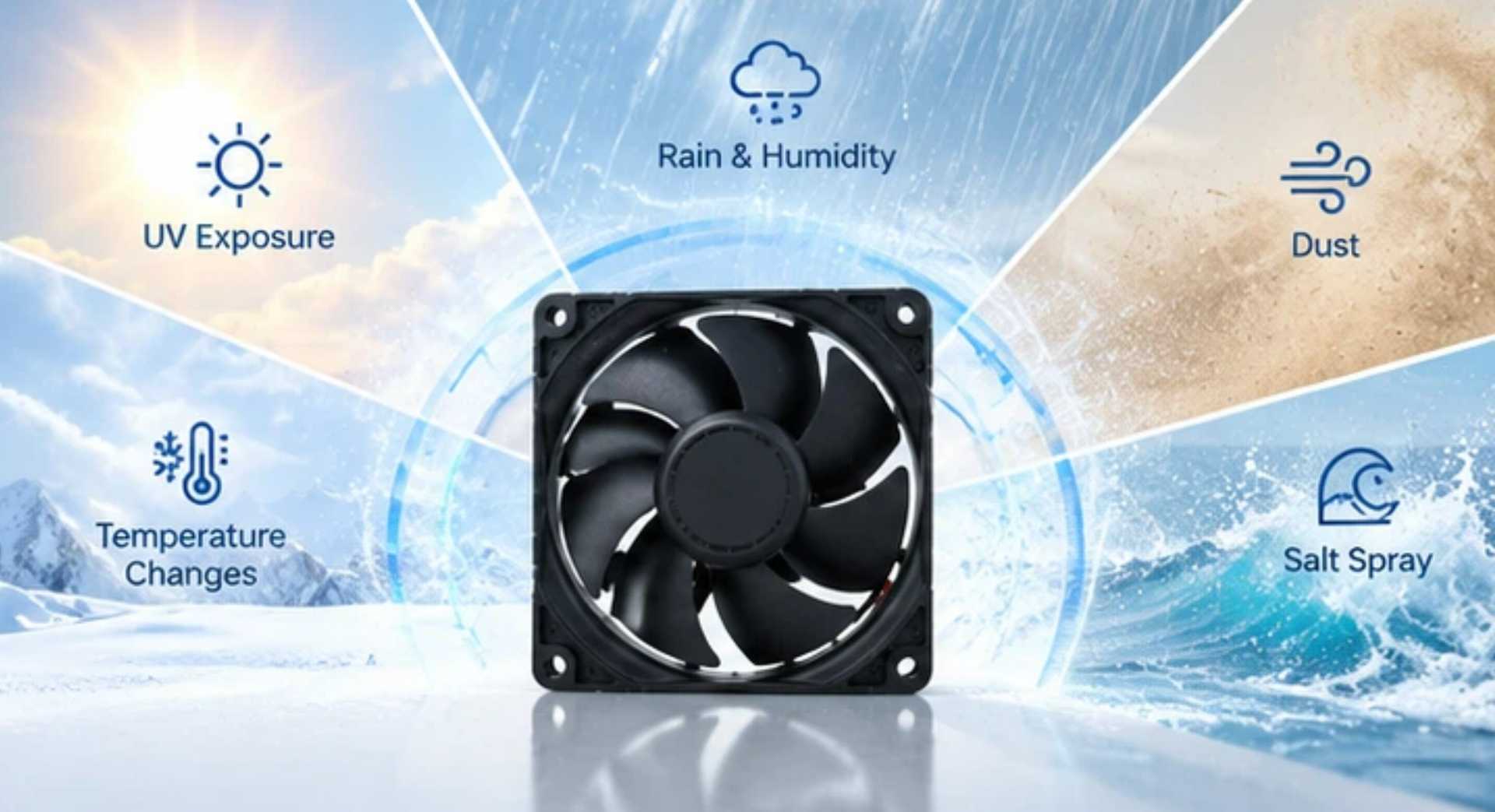
September 07 , 2026Los ventiladores de refrigeración para exteriores se utilizan cada vez más en equipos que deben funcionar continuamente bajo la lluvia, la humedad, el polvo, los cambios de temperatura, la niebla salina y otras condiciones ambientales exigentes. Los gabinetes de telecomunicaciones, las fuentes de alimentación para exteriores, los equipos de carga de vehículos eléctricos, los inversores solares, los gabinetes de control industrial, los sistemas de refrigeración, los equipos agrícolas, las pantallas LED y muchos otros sistemas dependen del flujo de aire forzado para disipar el calor. Sin embargo, cuando estos sistemas se instalan en exteriores, el rendimiento de la refrigeración es solo una parte de la ecuación de confiabilidad. La capacidad del ventilador para mantener su protección contra el agua y el polvo durante muchos años puede ser igualmente importante.
UnVentilador con clasificación IP68Está diseñado para proporcionar un alto nivel de protección contra el polvo y la entrada de agua. Sin embargo, la clasificación IP68 no garantiza que el sistema de sellado permanezca inalterable para siempre. La exposición al aire libre genera tensiones mecánicas, térmicas, químicas y ambientales constantes. Con el tiempo, los sellos pueden perder elasticidad, los adhesivos pueden deteriorarse, los puntos de entrada de cables pueden volverse vulnerables, las juntas de la carcasa pueden sufrir cambios dimensionales y la condensación puede generar humedad incluso cuando no entra agua de lluvia directamente en el equipo.
Esto significa que proteger un ventilador de refrigeración exterior contra la degradación del sello impermeable IP68 requiere una estrategia de confiabilidad completa en lugar de simplemente seleccionar un ventilador con la etiqueta IP68.
Para los fabricantes de equipos e ingenieros, la pregunta más importante no es solo si un ventilador puede superar una prueba IP68 cuando es nuevo, sino si la estructura de sellado, los materiales, los componentes eléctricos, los cojinetes, las conexiones de cables y el entorno de instalación del ventilador pueden seguir funcionando de forma fiable durante toda la vida útil prevista.
¿Qué significa realmente la clasificación IP68 para un ventilador de refrigeración para exteriores?
El código IP se utiliza para describir el nivel de protección que ofrece una carcasa contra objetos sólidos y agua. El primer número se refiere a la protección contra partículas sólidas, mientras que el segundo se refiere a la protección contra el agua. IP68 representa un alto nivel de protección contra el polvo, junto con protección contra la inmersión en agua bajo condiciones de prueba específicas. Las condiciones exactas de inmersión asociadas a una certificación IP68 pueden depender de las condiciones de prueba declaradas por el fabricante y de los requisitos aplicables.
Esta distinción es importante para la selección de ventiladores de exterior.
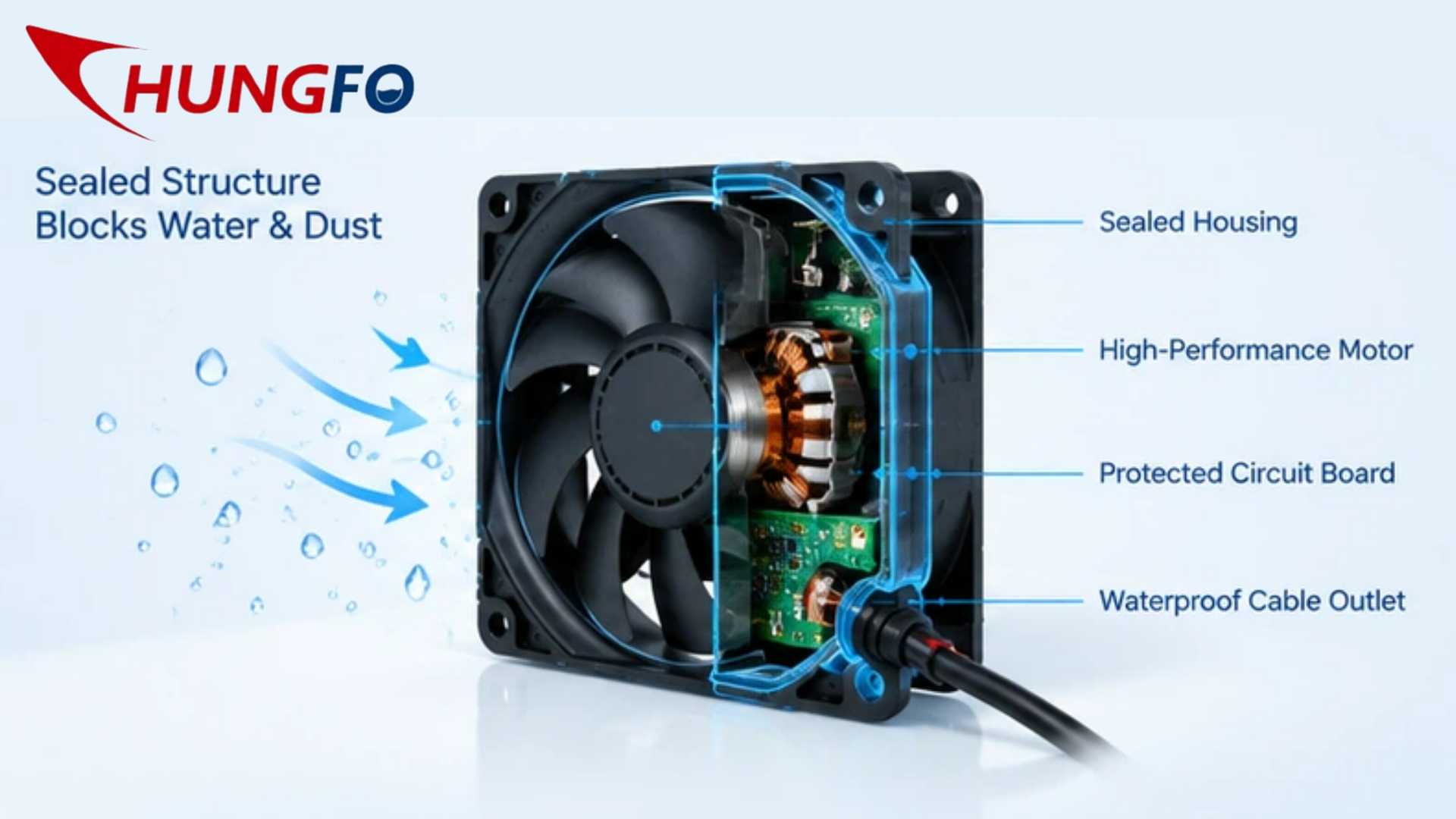
Un ventilador IP68 no es simplemente un ventilador convencional con una cubierta de goma. Para lograr una protección fiable, los fabricantes suelen controlar varias posibles vías de entrada de agua. Estas pueden incluir juntas de la carcasa, salidas de cables, conectores, estructuras de motores, placas de circuitos, zonas de rodamientos y otras interfaces.
Un ventilador impermeable bien diseñado puede utilizar combinaciones de carcasas selladas, protección con resina, recubrimientos de conformación, salidas de cable impermeables, rodamientos especializados, materiales resistentes a la corrosión y procesos de fabricación cuidadosamente controlados. Ejemplos de la industria demuestran que el encapsulado puede utilizarse para aislar los devanados y las placas de circuito impreso del entorno externo.
Sin embargo, el nivel de protección medido durante las pruebas de producción representa una condición particular en un momento específico. Los equipos para exteriores están expuestos a ciclos de temperatura repetidos, vibraciones, radiación ultravioleta, contaminación química y esfuerzos mecánicos. Estos factores pueden alterar gradualmente las propiedades de los materiales de sellado.
Por eso, la protección a largo plazo debe considerarse un problema de ingeniería a nivel de sistema.
¿Por qué los sellos impermeables IP68 pueden degradarse con el tiempo?
El error más común en el diseño de sistemas de refrigeración para exteriores es pensar que la impermeabilización es una característica permanente del producto. En realidad, cada sistema de sellado se ve afectado por su entorno.
La fluctuación de la temperatura es uno de los factores más importantes.
Un ventilador de exterior puede estar expuesto a noches frías, luz solar directa durante el día, superficies calientes, lluvias repentinas y cambios de temperatura estacionales. Las carcasas de plástico, las juntas de goma, los adhesivos, los componentes metálicos y los materiales de resina no necesariamente se expanden y contraen al mismo ritmo.
La expansión y contracción repetidas pueden ejercer presión sobre las interfaces.
Si un sello se endurece, se ablanda, se comprime, se hincha o se deforma permanentemente, su presión de contacto puede disminuir gradualmente. Un pequeño cambio puede no causar fugas visibles de inmediato, pero puede crear una vía de entrada para la humedad durante la exposición ambiental repetida.
Los ciclos térmicos también son importantes porque las carcasas electrónicas para exteriores pueden experimentar cambios de presión. Cuando el aire interno se calienta y se expande, y luego se enfría y se contrae, la carcasa puede sufrir fluctuaciones de presión. Durante largos periodos, estos ciclos pueden poner a prueba las interfaces de sellado débiles. Las investigaciones de ingeniería sobre carcasas selladas para exteriores han identificado la expansión y contracción térmica como posibles factores que contribuyen a fallos en el sellado y problemas de condensación.
La exposición a los rayos ultravioleta es otra preocupación.
Los ventiladores instalados en exteriores pueden estar expuestos a la luz solar durante miles de horas. Dependiendo del material, la radiación ultravioleta puede provocar decoloración, fragilización, agrietamiento superficial o pérdida de propiedades mecánicas. Por lo tanto, es importante seleccionar materiales adecuados para exteriores cuando la carcasa o la estructura de sellado del ventilador están expuestas directamente a la luz solar.
La humedad supone otro reto a largo plazo.
Un ambiente húmedo no requiere necesariamente el contacto directo con el agua para generar problemas de fiabilidad. La humedad puede migrar a través de interfaces vulnerables, conectores, estructuras de cables o defectos microscópicos. La alta humedad también puede acelerar la corrosión de componentes metálicos y contactos electrónicos.
La niebla salina puede ser particularmente agresiva.
Los equipos para exteriores instalados cerca de zonas costeras pueden estar expuestos a partículas de sal en suspensión y humedad. La contaminación por sal puede acelerar la corrosión de piezas metálicas, conectores, sujetadores e interfaces eléctricas. Por ello, los fabricantes de ventiladores ambientales suelen ofrecer diseños especiales resistentes a la corrosión para aplicaciones con presencia de niebla salina y humedad.
El polvo puede empeorar el problema.
Las partículas de polvo pueden acumularse alrededor de los sellos y las interfaces mecánicas. Si el polvo contiene partículas abrasivas o químicamente activas, el movimiento o la vibración repetidos pueden afectar gradualmente la superficie de sellado. Cuando el polvo se combina con la humedad, puede formar depósitos más difíciles de eliminar.
¿Cómo puede la carcasa del ventilador proteger el sello impermeable?
La carcasa del ventilador es la primera línea de defensa importante contra la contaminación ambiental.
Un ventilador exterior robusto debe tener una carcasa que minimice las aberturas innecesarias y cree interfaces de sellado controladas. Cuantas menos aberturas incontroladas existan, más fácil será mantener una protección ambiental fiable.
Las juntas de las carcasas deben diseñarse cuidadosamente.
Una simple unión mecánica puede no proporcionar suficiente protección a largo plazo a menos que se controlen adecuadamente las superficies de contacto, la compresión de la junta, las tolerancias y el método de fijación. Según el diseño, los fabricantes pueden utilizar juntas, compuestos selladores, relleno de resina, encapsulado, sobremoldeo u otras tecnologías.
El objetivo no es simplemente dificultar la apertura de la carcasa. El objetivo es crear una barrera estable contra el agua, manteniendo al mismo tiempo la integridad mecánica durante las vibraciones y los ciclos térmicos.
Para aplicaciones que requieren una protección ambiental especialmente alta, los componentes electrónicos internos también pueden protegerse mediante recubrimiento o encapsulado. Algunos diseños de ventiladores IP68 utilizan tecnologías basadas en resina para aislar los devanados y las placas de circuito sensibles del agua y la humedad.
Este enfoque proporciona una capa adicional de protección.
Si la carcasa externa presenta algún pequeño defecto, el encapsulado interno puede reducir la posibilidad de que la humedad alcance los componentes eléctricos sensibles.
¿Por qué la salida de cable es un punto crítico para la impermeabilización?
Muchos ingenieros prestan mucha atención a la carcasa del ventilador, pero subestiman la salida del cable.
El cable debe pasar desde la zona interna protegida al entorno externo. Esta transición crea una interfaz inevitable.
Si la salida del cable está mal diseñada, el agua puede filtrarse a lo largo del cable o a través de huecos alrededor del punto de entrada del cable.
Por este motivo, los diseños de ventiladores impermeables suelen utilizar salidas de cable moldeadas, compuestos de sellado, prensaestopas, conectores impermeables u otros métodos de sellado controlados.
El material del cable también es importante.
Los cables para exteriores deben soportar cambios de temperatura, exposición a rayos ultravioleta, humedad, flexión, vibraciones y, en ocasiones, productos químicos. Un cable que funciona bien en interiores no necesariamente ofrece la misma fiabilidad a largo plazo en exteriores.
Por lo tanto, la conexión entre el cable y el ventilador debe evaluarse como parte del sistema de impermeabilización completo.
Utilizar un ventilador IP68 de alta calidad con un conector externo sin protección puede crear un punto débil en el sistema. El ventilador puede ofrecer una excelente protección ambiental, pero el montaje final del equipo podría no ser así.
¿Cómo afecta la condensación a la fiabilidad de los ventiladores con clasificación IP68?
La impermeabilización y la condensación son dos problemas diferentes.
La entrada directa de agua se produce cuando el agua líquida penetra a través de una abertura o un sello dañado. La condensación se produce cuando la humedad presente en el aire se convierte en agua líquida debido a los cambios de temperatura.
Esta distinción es especialmente importante en los equipos electrónicos para exteriores.
Un recinto sellado puede contener aire húmedo. Durante el día, los componentes internos calientan el aire. Por la noche, el equipo se enfría. Si la temperatura interna alcanza el punto de rocío, el agua puede condensarse en las superficies más frías.
Por lo tanto, incluso una carcasa bien sellada puede sufrir humedad interna si el diseño térmico no está controlado adecuadamente.
Por lo tanto, los sistemas de ventilación para exteriores deben tener en cuenta tanto la protección contra la entrada de agua como la gestión de la humedad.
En algunos diseños de envolventes, se pueden utilizar membranas transpirables para igualar la presión y, al mismo tiempo, limitar la penetración de agua líquida. Estas soluciones deben seleccionarse cuidadosamente, ya que cualquier componente de ventilación adicional puede afectar la protección ambiental general de la envolvente. Las directrices de ingeniería para envolventes IP67 e IP68 suelen hacer hincapié en la igualación de presión y la gestión de la condensación como parte fundamental de la fiabilidad a largo plazo.
¿Cómo afectan los cambios de temperatura a las juntas de los ventiladores?
Los ciclos de temperatura suelen ser más perjudiciales a largo plazo que un único episodio de altas temperaturas.
Imagina un ventilador de refrigeración exterior funcionando dentro de un armario eléctrico. Durante el día, la radiación solar eleva la temperatura del armario. El ventilador funciona a alta velocidad porque los componentes electrónicos internos generan calor. Por la noche, el sistema se enfría rápidamente.
Este ciclo puede ocurrir todos los días.
La carcasa se expande y se contrae. Los materiales de sellado reaccionan de forma diferente. Los adhesivos sufren tensión. Las cubiertas de los cables cambian ligeramente de dimensión. Los lubricantes dentro de los cojinetes reaccionan a la temperatura. Los componentes electrónicos también experimentan estrés térmico repetido.
Over thousands of cycles, small changes can accumulate.
This is why outdoor fan qualification should consider the actual operating temperature range rather than only the nominal room-temperature condition.
Selecting a fan designed for the expected temperature range can significantly improve reliability.
The thermal design should also consider the difference between ambient temperature and the temperature inside the equipment. A fan operating in a 40°C outdoor environment may be exposed to a considerably higher internal temperature if the enclosure receives solar radiation or contains high-power electronics.
A suitable outdoor fan therefore needs both environmental protection and thermal capability.
How Can Material Selection Reduce Seal Degradation?
Material selection is one of the most effective ways to improve long-term environmental reliability.
Different rubber, plastic, resin, adhesive, and cable materials behave differently under ultraviolet radiation, heat, humidity, chemicals, and salt exposure.
For sealing applications, engineers should consider compression set, temperature resistance, chemical compatibility, water resistance, and aging characteristics.
For fan housings, material selection should consider mechanical strength, dimensional stability, flame resistance, corrosion resistance, ultraviolet exposure, and operating temperature.
For bearings, moisture resistance and lubricant stability are important.
For cables, flexibility, insulation performance, temperature resistance, and environmental durability should be evaluated.
A waterproof fan should therefore be selected as a complete engineered system rather than simply according to its external appearance.
How Important Are Bearings In An Outdoor Cooling Fan?
The waterproof seal protects electrical components, but the bearing system determines how reliably the impeller can rotate.
Outdoor environments can accelerate lubricant degradation and corrosion if the bearing structure is not suitable for the application.
Water exposure can be particularly damaging to conventional bearing systems.
A bearing that performs well in a clean indoor cabinet may experience different conditions in an outdoor agricultural machine, coastal power system, or industrial enclosure.
For long-life outdoor operation, engineers should consider bearing construction, lubricant characteristics, operating temperature, expected rotational speed, vibration, and environmental exposure.
Some manufacturers offer IP68 fans with specially protected ball bearings or other bearing solutions designed for demanding conditions.
The correct bearing selection also helps prevent secondary failures. If a bearing begins to develop excessive friction, the motor may consume more power, the fan may produce more heat, airflow can decline, and vibration can increase.
Therefore, bearing reliability is closely connected with the entire cooling system.
How Can You Protect An Outdoor Fan From Salt Spray?
Coastal installations require special attention.
Salt mist can reach outdoor equipment even when the fan is not directly exposed to seawater. Tiny salt particles can settle on surfaces and remain there when humidity is high.
Over time, salt contamination can accelerate corrosion.
The best strategy is to combine corrosion-resistant materials with appropriate sealing and, where necessary, additional surface protection.
Metal components should be selected according to the expected environmental conditions. Electrical connectors should have suitable environmental protection. The fan housing should prevent unnecessary exposure of sensitive components.
In particularly demanding applications, salt spray testing can provide useful information about material and surface durability.
A fan that is technically waterproof but uses materials that corrode rapidly may still have poor long-term reliability.
Therefore, IP68 should not be treated as a substitute for corrosion resistance.
How Can Installation Prevent IP68 Seal Damage?
Even the best waterproof fan can fail prematurely if it is installed incorrectly.
Mechanical stress is one of the most common installation-related problems.
If the fan frame is mounted against an uneven surface, excessive force can deform the housing. If screws are tightened unevenly, the sealing interface may experience uneven compression.
Cable routing is another important factor.
A cable should not be bent sharply near the sealed outlet unless the design specifically allows it. Excessive bending can place continuous mechanical stress on the cable entry.
The fan should also be positioned so that water does not remain unnecessarily around vulnerable interfaces.
If the application involves pressure washing, the direction and pressure of the water should be evaluated rather than assuming that an IP68 rating means unlimited resistance to every cleaning condition.
Installation instructions should therefore be treated as part of the waterproofing design.
Why Should You Avoid Relying Only On The IP68 Label?
The IP68 rating is valuable, but it is only one part of the product specification.
Two fans can both carry an IP68 designation while having different designs, materials, operating temperature ranges, expected lifetimes, corrosion resistance, bearing systems, and testing conditions.
For an outdoor application, engineers should ask additional questions.
What temperature range can the fan operate in?
What materials are used for the housing and sealing components?
How is the circuit board protected?
How is the cable outlet sealed?
What bearing technology is used?
Has the fan been tested under temperature cycling?
Has it been evaluated for salt spray?
What is the expected service life?
What are the airflow and static pressure characteristics?
Can the manufacturer provide reliability data?
These questions help transform IP68 from a marketing specification into a meaningful engineering parameter.
How Should You Test An Outdoor IP68 Fan?
Testing should simulate the actual environment as closely as possible.
A basic water ingress test is useful, but long-term reliability requires more than one test.
Temperature cycling can evaluate the effect of repeated expansion and contraction.
Humidity testing can help evaluate moisture resistance.
Salt spray testing can provide information about corrosion resistance.
Vibration testing can evaluate mechanical integrity.
High-temperature operation can reveal problems associated with seals, bearings, electronics, and lubricants.
Low-temperature testing can reveal changes in material flexibility and starting behavior.
Combined environmental testing can be even more valuable because real outdoor conditions rarely occur independently.
A fan may experience high temperature, humidity, vibration, and electrical load at the same time.
Manufacturers with appropriate testing capabilities can use environmental chambers, wind tunnel systems, pressure testing equipment, noise testing facilities, and other equipment to evaluate fan performance.
The purpose of testing should not be simply to obtain an IP rating. The objective should be to understand how the product behaves throughout its expected service life.
How Does Airflow Design Influence Waterproof Fan Reliability?
Waterproofing and airflow performance must be balanced.
Adding sealing structures, protective layers, or encapsulation can increase resistance to heat transfer or affect the internal thermal path.
At the same time, excessive restriction of the airflow path can reduce cooling performance.
An outdoor fan should therefore be selected according to the actual airflow and static pressure requirements of the equipment.
For example, asmall 12 volt dc mini fanmay be appropriate for a compact outdoor electronic module, but it may not provide sufficient airflow for a large industrial cabinet with high heat generation.
The key is not simply choosing the fan with the highest RPM.
A fan operating against high system resistance needs sufficient static pressure.
A fan operating in a relatively open airflow path may benefit more from high free-air volume.
This is why the fan performance curve should be considered during product selection.
The fan should be matched to the system operating point rather than selected based only on dimensions.
What Role Does Speed Control Play In Outdoor Fan Life?
Speed control can also contribute to long-term reliability.
If the fan operates at maximum speed continuously, it may generate more noise, vibration, power consumption, and mechanical stress than necessary.
If the equipment temperature varies significantly, variable-speed control can allow the fan to operate according to the actual cooling requirement.
PWM control is one possible method for controlling compatible DC fans.
By reducing unnecessary high-speed operation, the system may reduce mechanical stress and energy consumption.
However, speed control must be properly designed because operating a fan outside its recommended control range can affect starting reliability, acoustic performance, and motor temperature.
The appropriate control strategy depends on the fan design and the equipment requirements.
Choosing The Right Outdoor Fan For Different Applications
Outdoor telecom cabinets often operate continuously and can experience rain, dust, temperature fluctuations, and solar heating. A sealed DC cooling fan can help remove heat while limiting the risk of water and dust entering sensitive areas.
EV charging equipment presents another demanding application. Power electronics can generate substantial heat while the charger is installed outdoors. Waterproof cooling fans can help maintain thermal performance while improving environmental protection.
Solar inverter cabinets can also benefit from environmental fan solutions. Inverter electronics operate under varying outdoor temperatures, and reliable thermal management is essential for stable operation. Water ingress and condensation can create significant risks for electronic components, making environmental protection especially important.
Industrial automation equipment may be exposed to dust, humidity, oil mist, and vibration. The fan must therefore be selected according to the complete industrial environment rather than simply the expected temperature.
Agricultural equipment can face mud, moisture, dust, chemicals, and outdoor temperature fluctuations. In such conditions, corrosion resistance and mechanical durability become particularly important.
Marine and coastal equipment has an even stronger requirement for salt resistance.
Compact electronics may require a small waterproof fan. A Rocket RC Fan concept, for example, may be useful when discussing compact airflow requirements in remote-controlled equipment, hobby electronics, or small mechanical systems, but the exact environmental rating must always be confirmed from the actual product specification.
Why Should Manufacturers Consider Different Fan Structures?
Not every outdoor cooling requirement needs the same fan architecture.
Axial fans are widely used when a relatively large volume of air needs to move through a system with moderate resistance.
Centrifugal fans can be advantageous when the system requires stronger pressure against resistance.
Compact blowers may be useful when airflow needs to be redirected through a narrow duct or confined space.
An ac dc small fan can be useful when equipment requirements involve different power supply architectures or when the application needs a compact fan platform with flexible electrical configurations.
However, the electrical input should always be matched to the actual fan design.
A12V DC fan, a 24 V DC fan, and an AC fan should not be treated as interchangeable simply because their dimensions are similar.
How Can China Chungfo Fan Help With Outdoor Cooling Fan Selection?
For manufacturers developing outdoor electronic equipment, the fan is not an isolated component. It is part of the thermal and environmental protection system.
China Chungfo Fan focuses on cooling fan solutions for different equipment applications and can support requirements involving DC fans, AC fans, axial fans, centrifugal fans, blowers, and customized fan configurations.
The selection process should begin with the actual operating conditions.
The required voltage, airflow, static pressure, installation space, operating temperature, expected lifetime, noise requirement, environmental exposure, and protection level should all be considered together.
For an outdoor project, the application environment should be clearly described.
For example, a fan installed inside a sheltered outdoor cabinet has different requirements from a fan directly exposed to rain. A coastal application has different requirements from an inland factory. A solar inverter exposed to direct sunlight has different thermal conditions from an indoor control cabinet.
The more accurately the environment is defined, the more accurately the fan can be selected.
How Can You Build A Long-Term IP68 Protection Strategy?
The most effective strategy is to treat waterproofing as a lifecycle issue.
Start with the environment.
Identify rain, humidity, dust, salt, ultraviolet radiation, chemicals, vibration, temperature range, and cleaning requirements.
Then identify the thermal requirement.
Determine how much heat the equipment generates and where that heat needs to move.
After that, select the fan structure.
Choose axial, centrifugal, blower, or another design according to airflow resistance and available installation space.
Then evaluate the protection structure.
Look at housing sealing, cable exits, connectors, internal electronics protection, bearings, materials, and corrosion resistance.
Next, consider installation.
Make sure the mounting surface, screws, cable routing, drainage, and airflow direction do not compromise the sealing system.
Finally, test the complete system.
Do not test only the fan in isolation when the real application depends on the interaction between the fan and the equipment enclosure.
This system-level approach can greatly reduce the risk of premature waterproofing failure.
Maintenance Recommendations For Outdoor IP68 Fans
Even a highly protected fan should be included in the equipment maintenance plan.
The fan should be inspected periodically for visible damage, abnormal noise, vibration, corrosion, cable damage, and contamination.
The airflow path should remain clear.
Dust and debris can reduce airflow and increase motor load. If the fan is installed behind a protective grille or filter, that component should also be inspected.
In coastal environments, corrosion should be monitored more frequently.
If unusual vibration or noise appears, the fan should be evaluated before the problem becomes a complete failure.
Maintenance intervals should be based on the application environment rather than a universal schedule.
A clean indoor installation may require minimal inspection, while a coastal industrial installation may require much more frequent checks.
Common Mistakes When Using IP68 Outdoor Fans
One common mistake is assuming that IP68 means the fan can be exposed to any water condition indefinitely.
Another mistake is ignoring condensation.
A third mistake is installing an IP68 fan with a non-waterproof connector.
Another problem is selecting the fan based only on size.
Some engineers also focus on free-air airflow without considering system resistance.
Ignoring temperature is another common error. A fan may survive a short high-temperature event but have a much shorter service life if operated continuously at elevated temperatures.
Finally, some projects evaluate the fan but do not evaluate the complete enclosure.
The final equipment protection level depends on the complete system.
Conclusion
Protecting an outdoor air cooling fan from IP68 waterproof seal degradation requires much more than choosing a fan with a high IP rating.
The long-term reliability of an outdoor fan depends on sealing design, material selection, housing construction, cable protection, bearing technology, corrosion resistance, temperature management, condensation control, installation quality, and environmental testing.
IP68 provides an important level of environmental protection, but it should be viewed as one part of a complete engineering strategy. Real outdoor applications expose cooling fans to thousands of hours of thermal cycling, humidity, rain, dust, vibration, sunlight, and sometimes salt mist. These conditions can gradually influence sealing materials and mechanical components.
The best approach is to select a fan according to the actual operating environment, not simply according to a product label.
For compact electronics, a small waterproof fan may provide an effective balance between airflow and protection. For larger cabinets, engineers may need higher airflow and static pressure. For high-humidity or coastal environments, corrosion resistance and internal electrical protection become increasingly important.
China Chungfo Fan can provide different cooling fan solutions according to application requirements. By combining suitable airflow performance with appropriate environmental protection, equipment manufacturers can create cooling systems that are more reliable, durable, and suitable for long-term outdoor operation.
The key principle is simple: IP68 protection should not be treated as a single specification. It should be treated as a long-term reliability system.
FAQ
What does IP68 mean for an outdoor cooling fan?
IP68 indicates a high level of protection against dust and water ingress under specified testing conditions. The exact immersion requirements should be confirmed from the manufacturer's test specification.
Does IP68 mean a fan will never leak?
No. IP68 describes performance under defined test conditions. Long-term outdoor exposure can affect seals, cables, materials, connectors, and other components.
Why do outdoor fan seals degrade?
Temperature cycling, ultraviolet exposure, humidity, chemicals, salt mist, vibration, mechanical stress, and material aging can gradually affect sealing performance.
Can condensation occur inside an IP68 enclosure?
Yes. Condensation can occur when humid air inside an enclosure cools below its dew point. Waterproofing and condensation management should therefore be considered separately.
Is IP68 enough for coastal applications?
Not necessarily. Coastal environments can involve salt mist and corrosion. Material selection, connector protection, corrosion resistance, and appropriate environmental testing should also be considered.
Why is the cable outlet important?
The cable outlet creates a transition between the internal protected area and the outside environment. Poorly protected cable entries can become a potential water ingress path.
Should an IP68 fan be tested for salt spray?
For coastal or salt-exposed applications, salt spray or other corrosion testing can be useful for evaluating long-term environmental durability.
¿Cómo elijo el ventilador de refrigeración exterior adecuado?
Comience por considerar el voltaje, el flujo de aire, la presión estática, el rango de temperatura, el espacio de instalación, el nivel de ruido, la vida útil prevista, la humedad, el polvo, la exposición al agua, las vibraciones y las condiciones de corrosión. Luego, seleccione la estructura del ventilador y el nivel de protección correspondientes.
¿Es adecuado un pequeño ventilador de 12 voltios para equipos de exterior?
Puede ser adecuado para equipos compactos si su caudal de aire, presión estática, rango de temperatura, nivel de protección y durabilidad ambiental cumplen con los requisitos de la aplicación. No se debe seleccionar un mini ventilador de 12 voltios CC basándose únicamente en su voltaje y dimensiones.
¿Se puede utilizar un ventilador impermeable en un cargador de vehículos eléctricos?
Sí. Los ventiladores de refrigeración impermeables o con protección ambiental pueden utilizarse en equipos de carga de vehículos eléctricos para exteriores cuando su flujo de aire, rendimiento térmico, características eléctricas y clasificación ambiental sean adecuados para la aplicación.
¿Qué es más importante, el flujo de aire o la protección IP68?
Ambos aspectos son importantes. Un ventilador con excelente impermeabilización pero con un flujo de aire insuficiente no puede enfriar adecuadamente el equipo. Un ventilador de alto rendimiento sin la protección ambiental adecuada puede fallar prematuramente en exteriores.
¿Cómo puede China Chungfo Fan apoyar los proyectos de ventiladores para exteriores?
China Chungfo Fan puede evaluar el voltaje, el flujo de aire, la presión, las dimensiones, la temperatura, las condiciones ambientales y otros requisitos de la aplicación para ayudar a los fabricantes a identificar una solución de ventilador de refrigeración adecuada.